


 sales@worknroll.pro
 +48 (575) 631 844
Accounting for construction equipment and tools
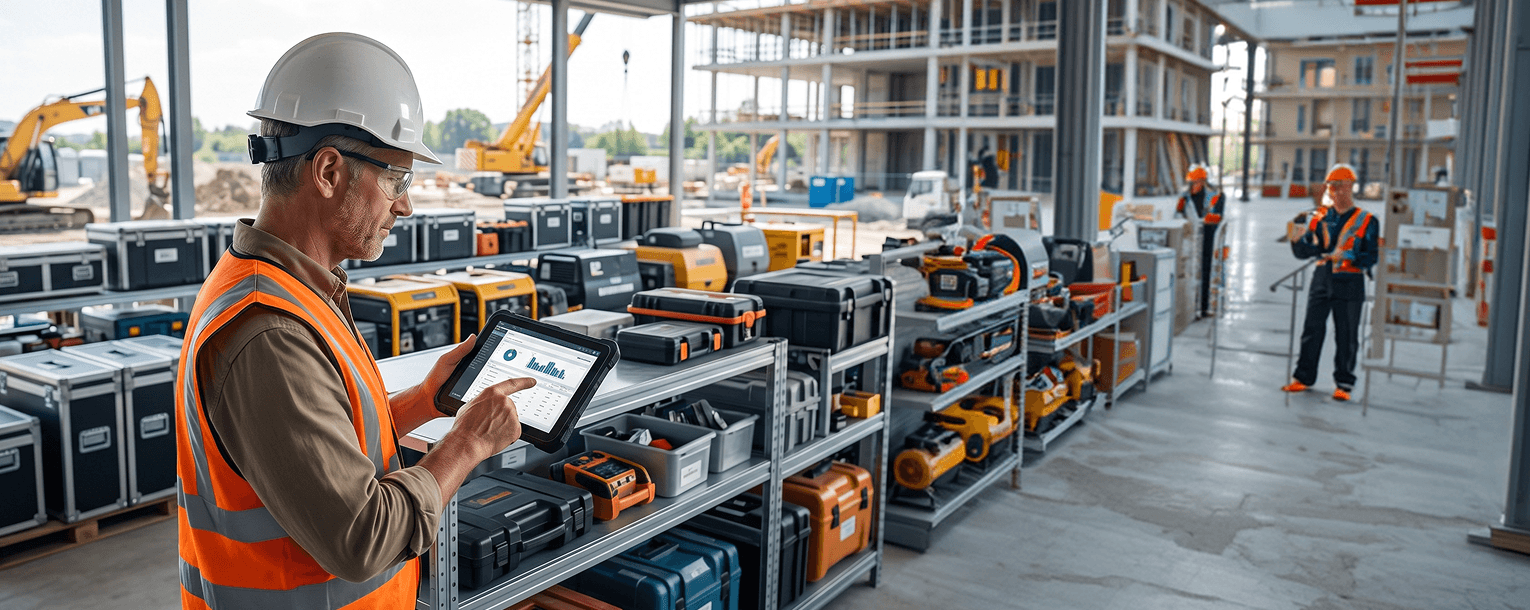

Equipment records and fixed assets on a construction site – how should equipment and tools be properly accounted for?
Managing assets on a construction site is one of the most demanding logistical and accounting tasks. Power tools, formwork, generators, machinery and small construction equipment are moved between different projects, personel and subcontractors. A lack of control over these resources leads not only to financial losses but also to irregularities in tax returns.
How can you distinguish between fixed assets and low-value items of equipment? What should a proper equipment register look like in a construction company to avoid chaos on site and problems with the tax office? In this article, we explain the key concepts, legal requirements and practical methods for managing equipment.
Fixed assets versus equipment – key differences under tax law
The key criteria for classifying business assets are their initial value and expected useful life.
- Fixed assets (ŚT) are assets (e.g. heavy construction machinery, excavators, delivery vehicles, and office containers) that are expected to be used for at least one year, are complete and fit for use, and have an initial value exceeding PLN 10,000 net (for VAT taxpayers). Fixed assets must be entered in the fixed asset register and are accounted for through depreciation over time.
- Equipment and low-value assets: These are items with an expected useful life of more than one year but an initial value not exceeding the PLN 10,000 net threshold (e.g. drills, grinders, ladders, and small measuring equipment). The purchase cost may be recognised directly as a tax-deductible expense in the month in which the item is placed into service.
Although, since 2020, tax regulations have no longer imposed a mandatory requirement to maintain a formal tax equipment register for PIT purposes, proper recording of equipment remains an essential element of internal control in every contracting company.
The equipment logbook – why is keeping it still worth it?
In the construction industry, the turnover of small equipment is extremely high. Without an up-to-date register, the rate of lost or damaged tools rises dramatically. A traditional paper equipment logbook, or its digital equivalent, fulfils several strategic functions:
- Accountability: It enables a specific tool to be assigned to a particular crew, employee or site manager on the basis of a handover report.
- Inventory and physical stock-taking facilitate routine comparisons between the actual stock and the book records.
- Operating cost control allows you to track the history of repairs, servicing and technical inspections for a given electrical tool.
What should the record of equipment quantity on a building site look like in practice?
In the construction industry, the traditional value-based (monetary) approach is often insufficient for a project manager. On a construction site, it is essential to keep a quantitative record of equipment, which answers the simple question: Where is a particular piece of equipment physically located and who is using it?
A proper equipment register on site should include:
- Inventory number / equipment identification code (e.g. a sticker with a QR code or a nameplate).
- The name and exact model of the equipment, together with its serial number.
- Date of commissioning and technical condition.
- Storage location of the equipment (name of building / building / central warehouse).
- Details of the person responsible (site manager, storekeeper, foreman).
- Date and purpose of the tool’s issue or return.
Paper records vs. digital records of construction site equipment
Keeping track of equipment in notebooks or Excel spreadsheets on a construction site leads to numerous errors. Tool issue cards get lost on site, data is entered late, and the company’s management has no idea whether a particular drill is being repaired or has been transferred to another project.
The solution to these problems lies in the digitisation of stock and equipment management processes:
- Quick equipment issue: A warehouse clerk or foreman can record the issue of a tool to an employee via a mobile app in a matter of seconds.
- Transparent inventory tracking: The site manager can view the full stock of the on-site stockroom from their smartphone.
- History of transfers between sites: The system records every change in the location of equipment, eliminating the risk of having to search for lost machinery.
Accurate record-keeping of equipment in a construction company protects the business’s assets against theft, negligence and organisational chaos. Whilst fixed assets require strict accounting procedures, an efficient register of everyday equipment and tools is crucial for the smooth running of work on the construction site.
Want to avoid equipment losses and streamline the issuing of tools on site? Try the tool management feature in the work'n'roll app and gain a convenient tool for digital management of your company’s assets – directly from your mobile phone!



 sales@worknroll.pro
 +48 (575) 631 844

