


 sales@worknroll.pro
 +48 (575) 631 844
Health and Safety at Work (HSE) on a Construction Site

Health and Safety at Work (HSE) on a Construction Site
Construction sites are among the places with the highest risk of accidents across the entire economy. For both project managers and owners of contracting firms, the proper organisation of the working environment is not only a legal requirement but, above all, a matter of protecting people’s lives and health. How can we ensure that health and safety on a construction site is not merely a formality on paper, but a system that functions effectively?
In this article, we discuss the key legal regulations, the necessary documents and modern solutions that facilitate the day-to-day management of security procedures in the field.
What is health and occupational safety on a construction site, and who is responsible for it?
The construction sector is characterised by rapidly changing conditions and the simultaneous execution of tasks by different teams. For this reason, safety on a construction site requires a clear division of roles and constant coordination.
Under Polish labour regulations and the Construction Law, primary responsibility for health and safety at the construction site rests with the investor and the appointed site manager. Their key responsibilities include:
- Preparing or verifying the Health and Safety Plan (BIOZ).
- Coordinating the activities of individual subcontractors.
- Providing appropriate collective protective measures (e.g. guardrails, safety nets, and barriers to cordon off hazardous areas).
- Enforcing the use of personal protective equipment by manual workers (e.g. safety helmets, fall-arrest harnesses for work at height, and protective footwear).
Mandatory health and safety documents on a building site – what do you need to have?
During inspections by the National Labour Inspectorate or the building control authority, the completeness of the documentation is carefully verified. Failure to provide the required certificates may result in work being suspended and heavy fines being imposed.
Key occupational health and safety (OHS) documents on a construction site include:
- Health and Safety Plan: A document prepared by the site manager before work begins where the works are scheduled to last more than 30 working days and involve at least 20 persons working simultaneously, or where the nature of the works involves particular hazards.
- Safe Work Execution Instruction: A detailed instruction prepared by the contractor responsible for specific works (e.g. formwork installation or roofing works) before those works begin. It identifies the hazards associated with the works and specifies the measures to eliminate or mitigate them.
- Occupational Risk Assessment: Documentation identifying hazards associated with individual work positions, together with confirmation that each member of the work crew has been informed of and familiarised with the assessment.
- Personnel certificates and qualifications:
- Valid medical examinations, including confirmation of fitness to perform work at height where applicable.
- Certificates confirming completion of initial and periodic occupational health and safety training.
- UDT qualifications (issued by the Office of Technical Inspection), e.g. for operators of cranes, excavators, or mobile elevating work platforms.
What do HSE regulations on building sites say? The most important standards
The detailed rules governing the execution of construction projects are set out in the Regulation of the Minister of Infrastructure on health and safety at work during the performance of construction works. When analysing health and safety regulations on a construction site, particular attention should be paid to three areas:
- Work at heights: Any work carried out at a height of at least 1 metre above ground level requires appropriate safety measures. If collective protection measures (e.g. guardrails) cannot be used, the worker must wear a safety harness with a lanyard.
- Excavation and earthworks: Excavations deeper than 1 metre require the walls to be shored up or the slopes to be graded to prevent them from collapsing.
- Installation and electrical work: Temporary site switchboards must be adequately protected against water and unauthorised access.
Practical health and safety inspections and supervision in the field
Even the most well-prepared documents cannot guarantee safety if there is no ongoing monitoring of conditions on site. When organising effective health and safety on a construction site, it is worth adopting the following practices:
- Daily toolbox talks: a brief, 5-minute discussion of hazards led by the foreman before the start of a shift.
- Ongoing equipment checks: checking the technical condition of ladders, power tools and safety harnesses before each use.
- Recording of breaches and near-miss incidents: Recording hazardous incidents helps to eliminate errors before a tragedy occurs.
Are you in charge of HSE on a building site? Paper forms vs. modern digitalisation
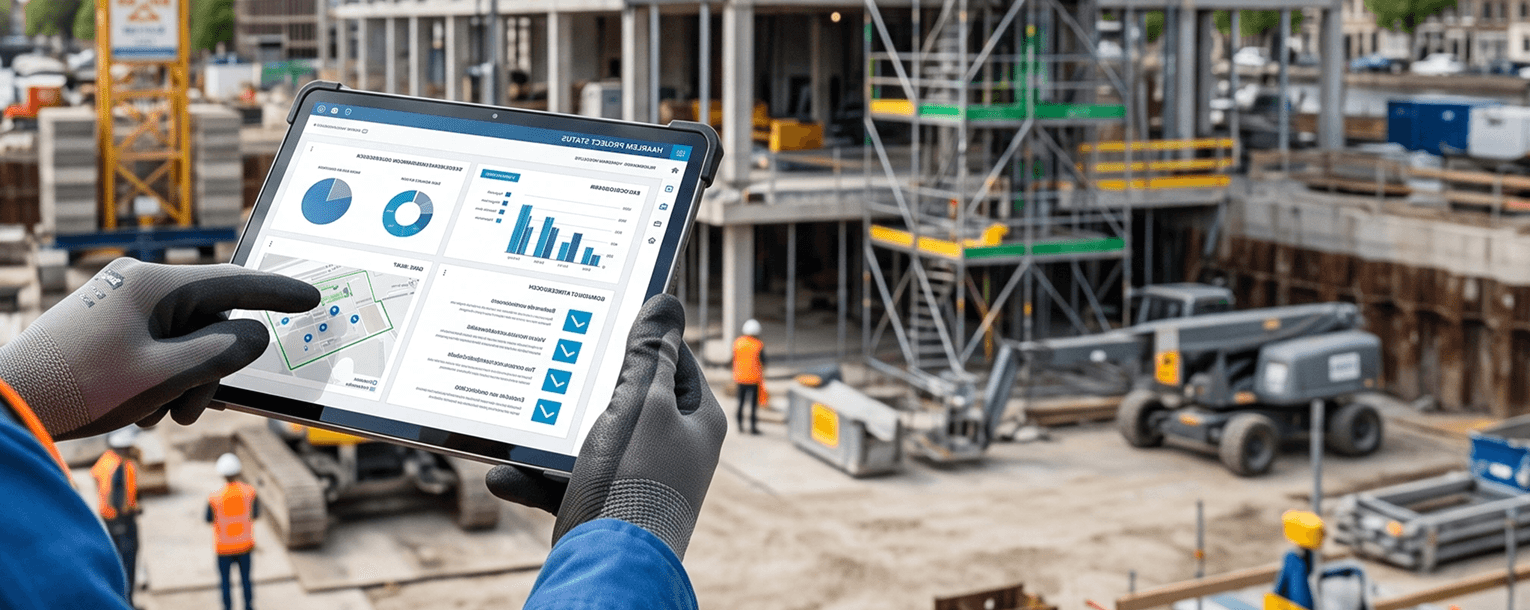
Traditional supervision of security procedures, based on paper checklists and logs, presents numerous challenges. Report forms get lost in the field, acknowledgement of the Safe Work Execution instructions is sometimes recorded late, and headquarters staff do not have an immediate overview of the security status at remote sites.
The digitalisation of construction processes is changing this situation:
- Quick verification of qualifications: The system allows you to check immediately via a smartphone whether a particular employee has valid health checks and training.
- Immediate reporting of faults: A manager or foreman can Safe Work Execution instructions or attended the daily briefing is recorded directly in the mobile app.
- Electronic acknowledgments: Confirmation that you have read the IBWR instructions or the daily briefing is done directly in the mobile app.
The proper organisation of health and safety procedures on site is not only about meeting the requirements of the National Labour Inspectorate (PIP), but above all a demonstration of responsibility towards the team. A modern approach to HSE is based on the efficient flow of information and the elimination of paper-based bureaucracy.
Do you want to streamline document management and monitor on-site procedures in real time? Find out how to implement the appropriate safety measures in the work'n'roll app and gain a convenient tool for coordinating construction work – directly from your smartphone.



 sales@worknroll.pro
 +48 (575) 631 844

